

The Real Reason Scaling Breaks Businesses
Most founders think scaling is a strategy and a bandwidth problem.
It could be a bandwidth issue, but usually it’s because the foundation has not been set.
Scaling is a structural problem.
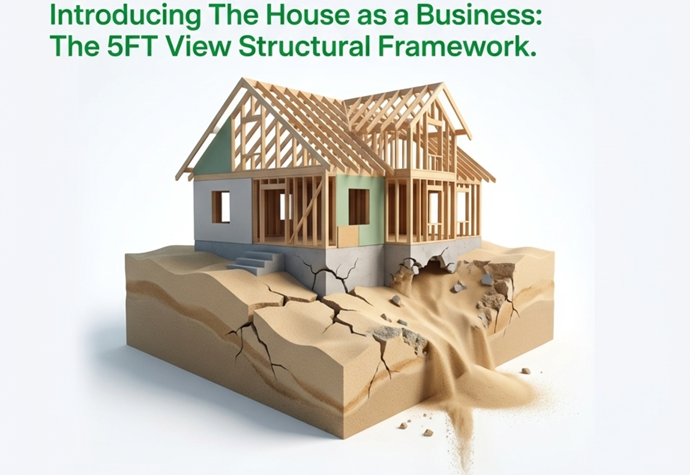
Strategy tells you where you want to go. Structure determines whether you can get there without the house falling into a sinkhole.
If you have ever said things like:
- “We are growing, but it feels harder every month.”
- “We keep hiring, but nothing gets easier.”
- “I’m still the bottleneck and I hate it.”
- “Everyone is working, but results are inconsistent.”
That is not a motivation issue. It is not a “try harder” issue.
It is a structural integrity issue.
A simple metaphor that founders immediately understand
A business is a house. Not a cute Pinterest house. A real one.
You do not measure a house by its paint color. You measure it by whether it can carry weight and survive the weather.
That is what scaling is.
More load. More stress. More storms.
Step one: the Blueprint
Before you build anything, you need a blueprint.
In business, your blueprint is your vision, mission, and purpose.
Not the framed poster version. The operational version that answers:
- What are we building, specifically?
- Why does it matter?
- What will we say yes to this year?
- What will we say no to, even if it is tempting?
- What does “winning” look like in measurable terms?
When the blueprint is fuzzy, teams compensate by building whatever seems urgent. You get motion without progress. You get activity without alignment. That is how founders end up running a company that looks busy, but feels unstable. And, key performers are burnt out from change fatigue.
A clear blueprint does not eliminate hard work. It eliminates wasted work.
Step two: the Foundation
The foundation is your organizational structure.
This is where many founder-led businesses unintentionally self-sabotage. They build the vision first, then try to “figure out roles” later. That works until complexity shows up.
A strong foundation means:
- The right people in the right seats with defined roles that fit the organizational needs, not simply provide jobs for the existing team
- Clear accountability for outcomes
- Actions that align with the objectives
- Shared commitment to the blueprint
- A structure that matches the stage of the company
Founders often confuse “good people” with “right people in the right seats.”
A strong contributor in the wrong seat still cracks the foundation.
Framing, walls, and load-bearing beams
Once the foundation is set, you build the framing. That is your teams, departments, and leaders.
This is where the real weight lives. Essential considerations are how work moves across functions, where handoffs break (or fail to occur), where priorities collide, where managers are expected to lead without tools, and where talented people quietly become overwhelmed.
If your leaders are carrying too much, they become the human equivalent of a stressed support beam. They are not failing. They are overloaded.
The visible parts founders blame first
Most founders blame the roof when the house is settling.
They look at:
- Marketing not converting
- Sales being inconsistent
- Clients getting a shaky experience
- Operations feeling reactive
Those issues are real. But they are often symptoms of earlier structural weaknesses like unclear ownership, inconsistent or unclear processes, decision bottlenecks, and inaction where action is needed.
If the house is structurally off, you can keep renovating the kitchen forever. It will still feel like the doors stick and the floor is unlevel.
The unseen systems that quietly determine scale
Your systems and processes are the wiring and plumbing.
They are not exciting. They are not supposed to be. They are supposed to be reliable.
When processes and systems are weak, founders become the operating system. Everything routes through them. That is not leadership. That is poor management.
And it erodes trust and motivation faster than ice cream on a hot day.
Visibility is not reporting. It is leadership awareness
Windows provide visibility.
A business without clear KPIs and operational rhythms is driving at night without headlights. When visibility is unclear, leaders usually micromanage to reduce their anxiety, demand various reports, or hold numerous meetings that suck the life and time out of everyone involved.
Neither scales.
Healthy visibility is simple:
- A small number of leading indicators
- A cadence for review
- Clear owners for each metric
- Clear actions when metrics are off track from the goal.
Culture is your curb appeal, whether you like it or not
Culture is what spills out into the yard.
If the inside is chaotic, the outside will eventually reflect it, resulting in retention issues, reputation drift, inconsistent client experiences, and leadership exhaustion that spreads like mold.
Culture is not perks. Culture is the lived experience of accountability, clarity, and trust.
The founder’s real job
Founders do not need to stop working hard. They need to stop carrying the load that should be carried by the structure.
Their job is to clarify the blueprint, reinforce the foundation, build the operating system, create visibility, develop leaders who maintain the foundation and manage remodeling.
That is what makes growth sustainable.
Because scaling is not about doing more.
It is about building a business that can hold more.