

Quick Summary / TL;DR
If you’re scaling revenue, headcount, or customers faster than your processes, systems, and leadership cadence can support, you’ll pay a “growth tax” in rework, churn, margin leaks, and burnout. The fix is to build infrastructure while you grow: clear operating rhythms, documented SOPs, accountable owners, clean financial visibility, and tech that actually fits how your team works. At 5FT View Consulting, we do that at the 5-foot level—not just strategy decks, but hands-on execution alongside your team (especially for growth-minded businesses in North America and Europe).
Have you ever felt like you’re building an airplane while it’s already in mid-air, only to realize you’ve forgotten to install the landing gear? Or, your race car has been out on the track for so long the tires are about to shred?
If you’re an ambitious SMB owner, this isn’t just a metaphor, it’s your calendar and your nerves (maybe your team member’s patience.). You worked hard to find product-market fit, sales are climbing, and the phone won’t stop ringing. But instead of celebrating, you’re up at 2:00 AM wondering why your team is fried, your margins are shrinking, and customers are suddenly complaining about things that used to be “easy.”
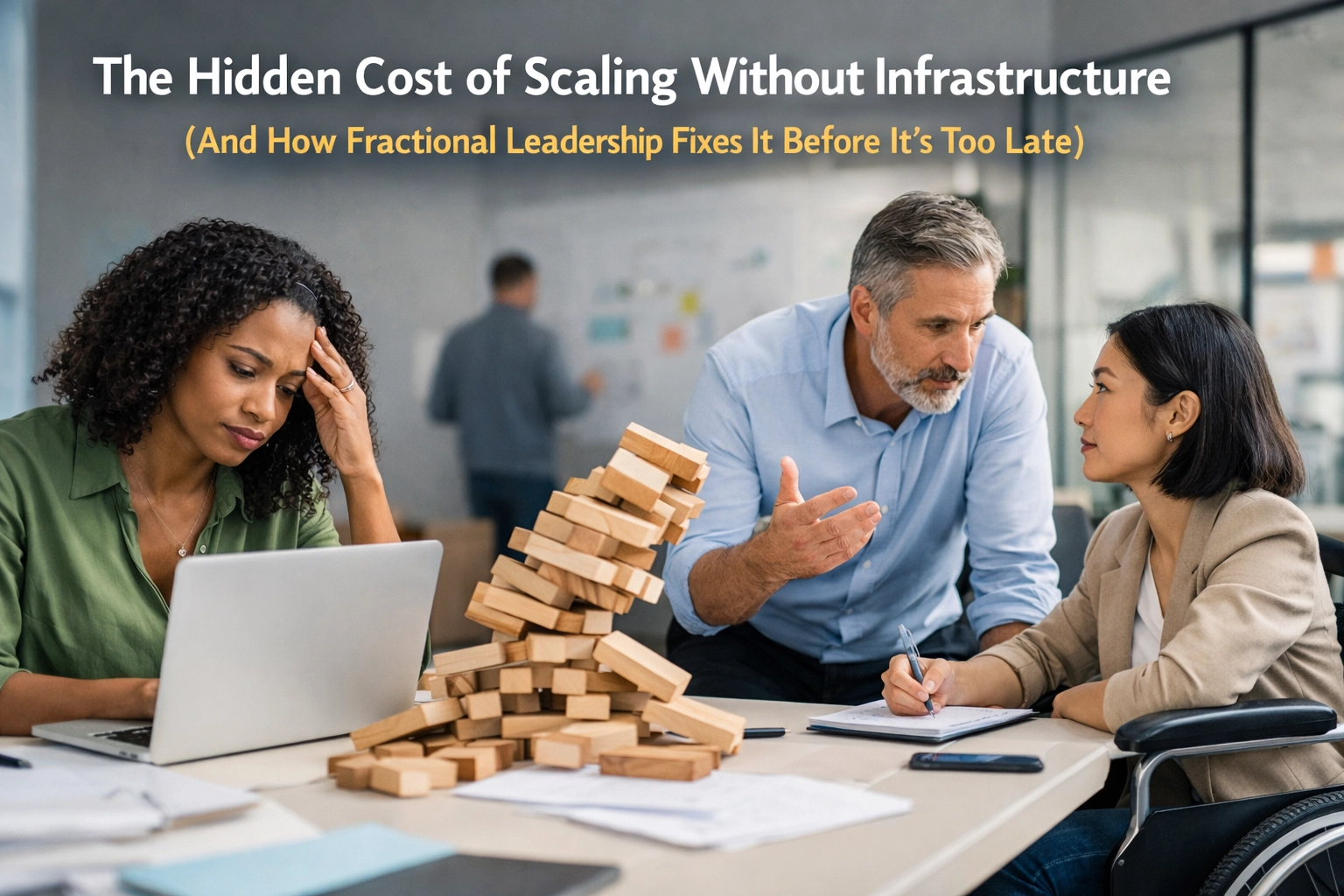
The truth is, you’re likely feeling the hidden cost of scaling without infrastructure. Growth is the goal but without a solid foundation, rapid expansion can become the very thing that sinks your ship.
Let’s explore what the “growth tax” really looks like and how you can fix it before it bankrupts your vision.
The 3 hidden costs of scaling too fast
When you scale without the right operational, financial, and leadership systems in place, you enter reactive chaos. Growth outpaces your internal capacity, so you patch problems with “duct-tape” solutions that work today and quietly create ten more problems for tomorrow.
If you’re in a fast-moving market the pressure to move at lightspeed is real. But the faster you go, the more expensive it gets to run on vibes and heroics.
Hidden cost #1: Operational drag (aka “rework eats your calendar”)
When your processes live in people’s heads, you pay for it in repeats, misunderstandings, and constant “quick check” messages.
Look for these signs:
- Your team fixes the same issues weekly (handoffs, billing errors, missed steps, deliverable re-dos).
- Projects stall because nobody knows the “right way” to do the work.
- Firefighting becomes the job, not an occasional moment.
Consider this: every hour spent on rework is an hour not spent on delivery, innovation, or customer experience. That’s not just annoying; it’s a growth limiter.
Hidden cost #2: Margin leakage and cash surprises
Scaling can increase revenue while profit quietly disappears. Why? Because pricing, delivery, and overhead aren’t engineered for scale yet.
Common culprits:
- Scope creep without a change-order process
- Over-hiring “just in case” because forecasting isn’t reliable
- Tool sprawl (too many systems, too little adoption, duplicative licenses, no clean reporting)
And when systems fail, the dollars hurt. Widely cited industry guidance referencing Gartner pegs average IT downtime at $5,600 per minute (a classic benchmark used to illustrate how quickly small failures become expensive). Even if your business isn’t “enterprise,” the point holds: small breakdowns compound fast when volume increases.
Hidden cost #3: Leadership bottlenecks and talent attrition
If every decision routes through you, you aren’t leading. You’re acting as the system.
You’ll usually see:
- Decision fatigue (every small question escalates)
- Quality erosion (great work becomes inconsistent)
- High performer burnout (your best people get tired of chaos and leave)
If you’ve caught yourself thinking, “I’m the only one who can do it right,” you don’t have a people problem. You have an infrastructure gap. The good news is, it’s fixable.

The Dollar Sign on Chaos: What under-infrastructure really costs
These costs aren’t theoretical. They show up as real dollars, real delays, and real stress.
Let’s make the “hidden growth taxes” practical:
- Tech debt (manual work disguised as “how we do it”): When your team runs core workflows in spreadsheets, inboxes, and tribal knowledge, you’re paying for duplication and errors, often tens of thousands per year in wasted labor and delayed billing.
- Customer churn (service cracks under volume): If your infrastructure can’t handle a 20% increase in tickets, orders, or projects, customers feel it immediately and they don’t usually announce they’re leaving.
- Premature fixed costs (locking in overhead too early): Under pressure, leaders sign long-term leases or high-ticket software contracts that don’t flex with revenue, creating a financial burden if the market shifts.
> The numbers tell a compelling story: scaling without infrastructure doesn’t just slow you down, it quietly taxes every part of the business until “growth” starts feeling like damage control.
The 5FT View Solution: Fractional leadership in action (built at the 5-foot level)
This is where fractional leadership changes the game especially when it’s paired with hands-on execution, not just high-level advice.
Many SMB owners think the only options are:
- DIY (you carry the load)
- hire a full-time executive (big cost + long ramp)
- or bring in a traditional consultant (recommendations, then goodbye)
At 5FT View Consulting, we work differently. We operate at the “5-foot level” in the trenches with you and your team so the infrastructure doesn’t just look good on paper. It gets built, tested, adopted, and owned.
Here’s what that looks like in real life:
- Operating cadence + accountability: Weekly leadership rhythms, KPI visibility, clear owners, and decision rights so everything doesn’t bounce back to you.
- SOPs that people actually use: We capture the “way work really happens,” simplify it, and document it so it’s repeatable (and trainable).
- Financial clarity that supports scaling: Not “check the bank balance and hope,” but forecasting, margin visibility, and cash planning you can make decisions with.
- Tech + AI that reduces friction: We implement AI and analytics where it makes sense – automation, reporting, handoffs, so output scales without chaos.
- Change management: The unsexy part that matters. We help your team adopt the new way of working so the infrastructure sticks.
This can include a Fractional COO to stabilize operations, a Fractional CFO to tighten financial controls and forecasting, or a Fractional CMO to align growth messaging with delivery. The goal is the same: build infrastructure before growth breaks it.
Geographic focus: North America and Europe
If you’re scaling in North America you’re playing in a market with fast hiring cycles, aggressive competition, and real pressure to professionalize operations quickly. If you’re scaling in Europe you’re navigating dense networks, complex stakeholders, and often tighter compliance expectations where “we’ll figure it out later” gets expensive fast.
In both cities, the winners aren’t the businesses that hustle the hardest. They’re the businesses that install the right operating system early (before too much irreversible damage) so growth feels like momentum, not mayhem.

The 5FT View: Why strategy without execution is just a wish
At 5FT View Consulting, we see a lot of “30,000-foot” consultants. You know the type: they fly in, drop a 50-page slide deck, and fly out leaving you to translate theory into Tuesday morning reality. And, all you want to do is sit down for a meal, or get a few hours of sleep without worrying.
We don’t do that. We operate at the “5-foot level.”
Our philosophy is simple: strategy is only valuable when it becomes installed behaviors, usable tools, and repeatable systems. That means we roll up our sleeves, partner with your team, and build infrastructure that works in the real world, not just in a perfect-world org chart.
Whether it’s tightening your processes, building a smoother handoff from sales to delivery, or making your reporting actually match what’s happening on the ground, we focus on the execution gaps that silently drain growth.
Is It Too Late to Start?
The short answer? No. But the longer you wait, the more expensive the “fix” becomes.
If you’re feeling the weight of your own success, it’s a sign that your current infrastructure has reached its limit. Assess your bottlenecks today. Where is the friction? Is it in your sales handoff? Your billing? Your project management?
Invest in your foundation now. Whether you’re in the heart of Washington, DC or the center of London, the businesses that survive the “scaling gap” are the ones that prioritize infrastructure before the roof starts to leak.
Let’s Build Something Built to Last
Scaling shouldn’t feel like a slow-motion car crash. It should feel like an exciting evolution because you’re building something that lasts.
When you bring in fractional experts like the team led by Stephanie Warlick or our diverse group of experts you get the perspective of seasoned executives and the hands-on “let’s get it done” energy that growth requires.
If you’re scaling in Atlanta or Paris, and it feels like you’re one missed handoff away from chaos, you’re not behind you’re at the exact moment where infrastructure becomes your advantage.
Are you ready to stop firefighting and start leading? Let’s take a look at your business from the 5-foot level and build the infrastructure your vision deserves.
Check out our Testimonials to see how we’ve helped businesses like yours navigate the complexities of growth.
> “Infrastructure is the invisible bridge between where you are and where you want to be. Don’t wait until you’re halfway across to realize it’s missing a few planks.”
Actionable Steps for SMB Owners This Week:
- Audit Your Time: Track how many hours you spend on “repetitive fixes” versus “strategic growth.” If it’s more than 30% on fixes, you have an infrastructure gap.
- Identify One Process: Choose your most chaotic process (like onboarding a new client) and map it on one page. If it looks like a bowl of spaghetti, it’s time for a system.
- Stabilize One Metric: Pick one number you’ll review weekly (delivery cycle time, gross margin, cash runway, churn, backlog). What gets measured gets managed.
- Talk to a Fractional Leader: Explore who we serve to see if a fractional approach aligns with your current growth stage.
Frequently Asked Questions (FAQ)
What does it mean to “scale without infrastructure”?
It means revenue, customers, or headcount are growing faster than your processes, systems, and leadership cadence. You end up relying on heroics instead of repeatable operations.
What are the early warning signs you’re under-infrastructured?
Repeated rework, constant escalations to you, inconsistent quality, messy handoffs, margin surprises, and a team that feels perpetually behind, despite working hard.
Is “fractional leadership” the same as consulting?
Not really. Traditional consulting often ends with recommendations. Fractional leadership pairs strategy with ownership and execution, so the systems get built and adopted, not just suggested.
What does “5-foot level” execution look like at 5FT View?
It looks like building SOPs with your team, setting up meeting rhythms and KPIs, clarifying roles, fixing handoffs, improving forecasting, and implementing tools that match how you actually work side-by-side with your people.
What does “5-foot level” feel like for a leader?
It feels like relief. Like one founder said to us the other day “I’ve been trying to get that done and losing sleep for months. You just came in and took care of it.”
How fast can you realistically build infrastructure?
You can usually create meaningful traction in 30–60 days (clarity, cadence, first SOPs, baseline KPIs). Deeper infrastructure, like reporting maturity, forecasting accuracy, and cross-team handoffs, typically strengthens over 90+ days. That said, we can save money and fix things in hours to days.
Do you work with businesses in North America and Europe?
Yes. We support growth-stage businesses in many areas across North America and Europe and are even beginning work in Australia, helping leaders build operational and financial infrastructure that keeps pace with demand.
Future-proof your business today. The cost of waiting is simply too high. Let’s get to work.