
Are you trying to scale, modernize, and keep up with AI: without signing up for another big consulting bill (or a $250k+ executive salary) before you’re ready?
Let’s be real: traditional consulting isn’t “dead.” But it is changing fast. The consulting world isn’t
experiencing a sudden death: it’s undergoing a remarkable evolution: and fractional leadership
(paired with practical AI integration) is a big reason why.
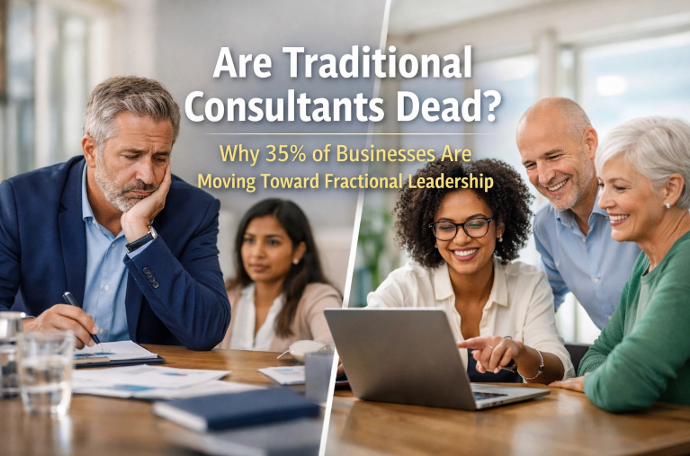
And this time, the data backs up the direction of the shift. 35% of U.S. companies are projected to employ at least one fractional executive by 2025, which tells you this model is quickly becoming mainstream: not just a “scrappy startup” move. (Source: World Economic Forum, Future of Jobs Report 2025.)
And the momentum is showing up in adjacent models too: interim C-level placements are up 310% since 2020, reflecting how quickly companies are turning to flexible, on-demand leadership when the stakes are high and time is tight. (Source: Fortune, citing Heidrick & Struggles data, 2025.)
The Real Story Behind Consulting’s Transformation
Traditional consulting isn’t dead, but it’s definitely not the same animal it was five years ago. Think of it like the music industry: streaming didn’t kill music, but it completely transformed how we consume it. The consulting world is experiencing its own “streaming revolution,” and fractional leadership is leading the charge. What’s driving this change? Three major forces are reshaping how businesses think about external expertise:
Economic pressure is pushing companies to maximize every dollar spent on leadership and strategy.
Digital disruption is creating needs for specialized skills that didn’t exist a decade ago. And workforce flexibility has become not just a nice-to-have, but a competitive advantage.
The numbers tell a compelling story. 80% of executives now consider AI critical to their operations, and the demand for fractional and interim executives keeps accelerating. In fact, interim C-level placements have grown 310% since 2020 as companies look for seasoned leadership: fast: without the long ramp time of a permanent hire. (Source: Fortune, 2025; citing Heidrick & Struggles.)
Translation? You can access C-suite level expertise without the C-suite level commitment, and you can pair it with AI-enabled execution so strategy doesn’t sit in a slide deck.
Why Fractional Leadership Is Having Its Moment
Remember when hiring a full-time executive felt like the only “serious” option? Those days are fading fast. Fractional leadership has evolved from a cost-cutting measure to a strategic advantage that forward-thinking companies are embracing.
Here’s what’s driving this shift:
Cost Efficiency That Actually Makes Sense
Let’s explore the part everyone thinks about first (and yes, it matters): cost. Fractional leadership isn’t “cheap leadership.” It’s right-sized leadership: senior expertise matched to the stage you’re actually in.
Here’s what that can look like by role:
• Fractional CEO (Vision + transition leadership without the $250k+ salary)
If you’re in a pivot, post-acquisition integration, founder transition, or “we outgrew our old way of operating” moment, a fractional CEO can set high-level vision, align the executive team, and
steady the ship: without a $250k+ base salary (plus bonus, benefits, and equity) before you’ve
proven the long-term need.
• Fractional COO (Scalable systems + operational infrastructure)
A full-time COO makes sense when complexity is permanent. But if your pain is “we’re growing and everything is breaking,” a fractional COO helps you build scalable systems, operational cadence, accountability rhythms, and the infrastructure that keeps growth from turning into chaos: without carrying that cost year-round.
• Fractional CFO (Complex financial oversight + cost management when it matters most)
Finance leadership is where many companies feel the pressure first: cash flow, runway, margins,
pricing, forecasting, debt, investor reporting, and cost control. Notably, CFOs represent 51% of
interim C-level requests, because organizations need experienced financial oversight and disci
plined cost management during volatility and growth. (Source: Fortune, 2025; citing Heidrick &
Struggles data.)
• Fractional CMO (Strategic marketing without full-time overhead)
A full-time CMO in a major market can easily cost $200,000-$300,000 annually, plus benefits, equity, and the risk of a bad hire. A fractional CMO brings the same strategic thinking and execution capability at a fraction of that cost: often 30–50% less: while delivering immediate impact.
But it’s not just about saving money. It’s about smart money allocation. Instead of locking into one person’s skill set, you can access the right leadership at the right intensity as your needs evolve: and invest the difference into the areas that compound (like AI-enabled systems, better data, and stronger talent).
Flexibility in an Unpredictable World
Your business doesn’t need the same leadership intensity year-round. During a major product launch, you might need intensive marketing leadership. During operational optimization, you need someone with process expertise. Fractional leadership lets you scale expertise up and down based on actual business needs, not organizational charts.
Access to Elite Talent
Here’s something traditional consulting firms don’t want you to know: many of their best people are going fractional. Why? Top-tier executives are choosing the flexibility and variety that fractional work provides. This means you can often access talent that would have been locked away in big consulting firms or unavailable as full-time hires.
The AI Integration Revolution
Now, let’s talk about the elephant in the room: AI. Traditional consulting firms are struggling with how to integrate AI capabilities while maintaining their billable hour models. Fractional leaders, especially those with AI expertise, are positioning themselves as the bridge between traditional business operations and AI-powered futures.
The reality is stark: businesses need AI guidance, but they don’t need it 40 hours a week, 52
weeks a year. They need strategic thinking about AI implementation, help navigating the technology landscape, and leadership during digital transformation initiatives.
This is where AI-powered fractional leadership shines. You get:
• Strategic AI planning without the overhead of a full-time Chief AI Officer
• Implementation guidance from leaders who’ve successfully deployed AI solutions
• Change management expertise for teams adapting to AI-enhanced workflows
• Risk assessment capabilities for AI adoption without the risk of a bad full-time hire
What This Means for Your Business
If you’re still thinking about external expertise the way you did in 2019, you’re missing opportunities.
The question isn’t whether to use external expertise: it’s how to access the right expertise in
the most efficient way possible.
Consider these scenarios:
Scenario 1: Traditional Consulting You identify a strategic challenge, spend weeks finding the right consulting firm, negotiate a contract, wait for them to staff your project, then pay premium rates for junior consultants to learn your business under senior partner oversight.
Scenario 2: Fractional Leadership You identify the same challenge, connect with a fractional leader who’s solved similar problems, and they’re executing solutions within days because they work at the leadership level, not the implementation level.
Which sounds more appealing? Which sounds more aligned with how fast your business needs to move?
The Hybrid Future of Business Consulting
Here’s what the consulting landscape actually looks like in 2025: it’s not traditional vs. fractional: it’s strategic combination. Smart businesses are building consulting portfolios that might include:
• Fractional executives for ongoing strategic leadership
• Traditional consultants for large-scale transformation projects
• Specialized contractors for specific technical implementations
• AI-powered tools for data analysis and process optimization
The companies winning in this environment aren’t choosing one model over another. They’re choosing the right model for each specific need.
Making the Shift: What You Need to Know
If you’re considering fractional leadership for your business, here’s what successful companies are doing:
Start with Clear Outcomes
Traditional consulting often begins with problem identification. Fractional leadership works best
when you’re clear about desired outcomes. Instead of “we need marketing help,” think “we need to increase qualified leads by 40% in six months.”
Think Integration, Not Replacement
The most successful fractional relationships happen when the leader integrates with your existing team, not when they operate in isolation. Look for fractional leaders who can build capability within your organization, not just deliver projects.
Plan for AI Integration
Whether you’re ready or not, AI is reshaping how business gets done. Your fractional leader should be helping you navigate this transition, not just managing traditional business functions.
The Bottom Line
Traditional consultants aren’t dead, but the consulting world has fundamentally changed. The businesses thriving in this new environment are those that access expertise strategically, not habitually.
Fractional leadership, especially when combined with AI capabilities, offers something traditional consulting often can’t: immediate access to senior-level thinking without senior-level overhead. It’s not about replacing your team: it’s about amplifying what your team can accomplish.
The trend is real: and the numbers are starting to catch up with what you’re seeing in the market. 35% of U.S. companies are projected to employ at least one fractional executive by 2025, and interim C-level placements have jumped 310% since 2020. In other words: flexible leadership is becoming a normal lever for growth, not an emergency backup plan.
Businesses are choosing more flexible, efficient ways to access the expertise they need to grow.
The question is: will you be part of this evolution, or will you stick with models that worked in a different era?
The future belongs to businesses that can access the right expertise at the right time for the
right price. Traditional consulting taught us to think in terms of projects and reports. Fractional leadership teaches us to think in terms of outcomes and ongoing capability building.
Which approach sounds more aligned with where your business needs to go?